My Conversion
June 16, 2022
On this text I describe my process from atheism back to theism.
The process took around 5 years as I aged from 24 to 29. On this text I try to capture what I think were key moments. Before we dig into the details, below I present a summary of what I learned.
- From Richard Dawkins I learned I was not stubborn enough to call myself an atheist, and that I was actually agnostic.
- From Jordan Peterson I learned to appreciate the wisdom of old stories.
- From Hans Hermann Hoppe I learned the limits of Positivist Epistemology, and learned to trust rationality over sensory experiments.
- From a personal experience I learned the limits of extreme doubt, and acknowledged that I was already capable of faith;
- From Edward Feser I learned about a thorough logical discussion on the existence of God.
- Also from Edward Feser I learned about Scholastic Realism, which is the only satisfactory explanation for the problem of Universals. At this point, I started believing in God.
- From Maurice De Wulf I learned I had a soul and that God might actually care about us humans.
- From Huston Smith I learned of slightly messed up metaphysical views of Hinduism.
- From David Wood I learned totally messed up recommendations from Islamism.
- From a collection of small independent evidences, ranging from passages in the Old and New Testament to a personal experience, I concluded it is plausible that Catholics have the clearest path to eternal happiness, and I decided to give a try and experiment a life in Grace.
Richard Dawkins: only a proud stubborn fool calls himself an atheist
My mentor asked me how many books I had read on atheism. The answer was "None", and that caused me to list a few atheist authors, and for no particularly good reason I started reading with Richard Dawkins' "The God Delusion".
I really enjoyed the book back then. I recall I liked that not only the author set to argue against the existence of God, but he also tried to present a rational for moral in a world without God.
To my surprise though, I learned that I was not really atheist, and that it takes a fool to consider oneself an atheist. Deep down there, I was not sure God did not exist. At best I could call myself an atheist agnostic, meaning I was not sure God existed or not, but I tended towards believing God did not exist.
Jordan Peterson and the power of ancient symbols
My mentor also recommended me the book "12 Rules to Life". I don't really recall what was the sales pitch. It might have been that my life was a mess, and that I needed to put it in order. Anyways, I started listening to an audiobook of "12 Rules".
I left the book with an appreciation for what old stories were trying to teach us, and I started paying attention to biblical stories and other religious texts. I knew old stories had valuable lessons to teach, and that many modern problems were caused by a culture that tries to ignore such stories.
Austrian Economics and the limits of sensory knowledge
Austrian economics was a recurrent topic around my circle. During a vacation I downloaded an introductory course on Austrian Economics.
I spent 2 weeks traveling around Bahia, and whenever I was commuting, I was listening to Hans Hermann Hoppe and Jörg Guido Hülsmann on how men take action, and the long term consequence of such actions. This course was big eye opener and made the whole of world make more sense.
To my surprise, the course left me with a key insight on the problem of knowledge: experience alone is not enough to explain our knowledge about the world. Lesson 6, on praxeology, left me with an understanding that rationality contained elements more primitive than sensory experience.
I learned that my previous understanding of knowledge was heavily influenced by Positivism, which claims that all knowledge is either a) experimental or b) a definition. The Austrian argument consists in asking if the previous claim is either experimental or a definition.
A Personal Experience
One afternoon when I was alone and left to my thought, I started seriously doubting my own existence, and I think this led me to a panic attack, as I became aware I was not in control of the situation. I was afraid that in doubting my own existence, I would do something that I would regret forever.
In order to survive the experience, I kept repeating for myself a combination of the following:
- Only a thing that exist can doubt about its own existence.
- Doubt is a useful tool, but can't be all I have. I decided to believe that I existed, and I won't doubt it anymore.
Reflecting later about what had happened, I realized I was already capable of faith. I realized that extreme doubt could set a mind into livelock, and that if doubt was really our only tool, we would not be alive today.
The Unmoved Mover and The One
During a group discussion, a friend mocked Richard Dawkins. He called his books "child game", and he stated that Dawkins could only argue w/ drunk people on the street, and that he could never argue against true theologians. I tried to defend Dawkins, and this friend recommended me the book Five Proofs of the Existence of God.
The book has 7 chapters:
- 1~5: one proof per chapter
- 6: a chapter about the relationship between God and the world
- 7: a rebuttal of common proofs against God (including the kind of argument raised by Richard Dawkins)
The first chapter on the Aristotelian proof hit me like a rock. I had never seen any argument as detailed as the one presented by Edward Feser. Not even in my college math classes. It was clear to me how Richard Dawkins was "child game".
Below I try do document my understanding of this proof. In the hope of making the discussions more clear to functional programmers, I tried to write F# definitions for some of the concepts.
Change and Causality
The proof starts with the observation that change is real in the world. Plus, in trying to understand change, we are introduced to the concept of potency and actuality: change is the actualization of potential - to turn in to actuality something that was previously in potentiality.
Finally, there exists rules that governs change and these are captured in the Theory of Causality. In particular, when trying to identify the action by reason of which a being A which is capable of becoming A' actually becomes A', the theory says that such actions must come from without. That is: whatever changes is changed by something other than itself.
Let's see if F# can help us understand change. Below I present type definitions for the things that constitute the real world.
// In a loose ssense, the things you can touch an measure
// Note: there cannot exist more than 1 of things which don't have
// prime matter. This is the reason why we can write 0 + 1 = 2 - 1;
// That is: all times we encounter a number 1, we are encountering
// the same number 1
type PrimeMatter = | PrimeMatter

// The form (relation between parts) that defines what a thing is;
// examples:
// - the number "1"
// - the things that makes your snake your specific snake even though
//   it changes its entire body
// - your soul
type SubstantialForm = | SubstantialForm

// Examples:
// - The number 1 exists, even though it does not have prime matter.
// - A unicorn, on the other hand, is a collection of accidents our mind
//   can put together. It is possible to talk about the form of a unicorn,
//   but such form does not have existence.
type Existence = | Existence

type Substance = {
    PrimeMatter: PrimeMatter option
    SubstantialForm: SubstantialForm }

type Accident = | Quantity | Action | Quality | Time | Space |
    Relation

type Essence = {
    Substance: Substace
    Accidents: Accident list
    // note: an essence can lose and gain accidents as change occurs
}

type Being = {
    Essense: Essence
    Existence: Existence option }

type World = Set<Being>
// note: numbers are part of the real world as much as you and the
// screen in front of you.
Next I present the theory of change and causality.
type StateOfBeing = {
    Actuality: Being
    Potentiality: Set<Being>
}

// Theory of Change
let isLegitEvolutionOfWorld state newState =
    state.Potentiality.contains newState
// note: should return true for all pair of sucessive states

// Theory of Causality
let isValidCausalRelation world stateOfBeing newState changer =
    if changer stateOfBeing then
        failwith "A being cannot be the efficient cause of its own change!"
    if not world.Actuality.contains changer then
        failwith "The changer must be already actual!"
    isLegitEvolutionOfWorld stateOfBeing newState
Hierarchical Causal Series
Another concept employed in the proof is that of an Hierarchical Causal Series (HCS). Below I try to introduce the concept with F#.
To begin with, a HCS is a chain of object.
type HCS = list
We will build this list out of objects we observe, and at first we
don't know if the list if finite or infinite. In any case, you start
building the list by picking an object o and a property p of this
object. If the property p is in o by reason of o's own nature,
then the HCS is complete. Otherwise, you find the object o2 which is
the cause of o having p, and add it to the list. You recursively
do this process and you only stop if you find an object that has
property p in its own nature.
Let's describe the construction of an HCS in F#:
type Object = {
    NaturalProperties: Set<Property>
}

var getCauseOfProperty: Object -> Property -> Object

let isNaturalProperty o p =
    Set.contains p o.NaturalProperties

let rec _buildHCS o p acc =
    if isNaturalProperty o p then o::acc
    else _buildHCS (getCauseOfProperty o p) p (o::acc)

let buildHCS o p = _buildHCS o p []
Let's give this function a try. Pick for example the object "Aristotle" and the property "to be Aristotle". Let's see what happens.
buildHCS (Object "Aristoteles") (Property "to be Aristoteles")
Result
["Aristóteles"]
Hm, not much fun. Now, let's evaluate "Aristotle" is respect to the property "not accelerating in respect to Earth's center". It seems reasonable that the following will happen:
buildHCS (Object "Aristóteles") (Property "not accelerating in respect to Earth's center")
Result
["Aristóteles"; "chair"; "floor"; "house foundation"; "Earth"]
The situation is illustrate in the following piece of art.
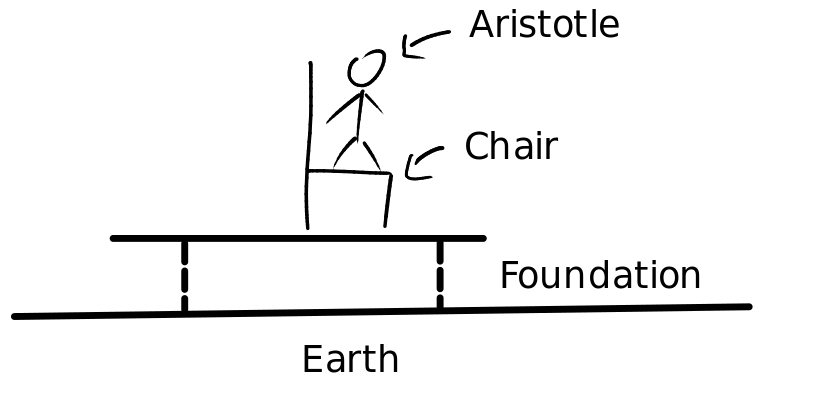
Figure 1: Aristotle not falling because he sits on a chair, which sits on a floor, which sits on house foundations, which sits on Earth
Now, the world before our minds is an interesting one. Sometimes we could start building an HCS but the objects of our experience don't seem enough to finish it. It could seem that the HCS is an infinite list. Or could it? We will see more in a moment.
A final note: it is important to note that an HCS is defined for a moment of time. The chain of objects being analyzed all exist concurrently, and the property is being passed concurrently from previous elements of the chain down to later members of the chain.
A HCS must terminate
Take a non-empty potentially-infinite HCS build around property p,
and let's build an auxiliary recursive function that tells us if the
occurrence of p in the HCS is completely understood
let rec hasCausalityFullyExplained hcs p =
    match hcs with ->
        | o::xs ->
            if isNaturalProperty o p then true
            else hasProperty xs p
        | [] -> false
The above is saying that:
- 1. If we run the entire HCS and have not found the source of the
property
p, then the HCS is not fully explained. - 2. If we find an object in the HCS that has the property
pin its nature, then the fact that theHCSis fully explained. - 3. If none of the terminating conditions happen, we enter into a
loop that never terminates. The answer to "is the causality
fully explained" will never be
true.
Now, recall once again that an HCS is constructed for a particular moment of time, and out of objects and properties that we do observe in that moment of time. To say that cases 1 and 3 above are real possibilities it is to say that there are changes happening in the real world whose causes are NOT in the real world. That of course is an absurd, from which follows that: ALL HCS ARE FINITE AND MUST TERMINATE IN A SOURCE MEMBER.
The Recursion That Must Terminate
- You, you that are reading this, you exist
- The parts that make you, they also exist, and they could be arranged in a variety of forms (permutations).
- All these permutations exist in potential, but, right now, only one of them, you, is in actuality.
- According to the theory of causality, this means that concurrently to your existence, there exists something else who is actualizing your potential for existence.
- This something else is either:
- a) something that has potential and right now is being actualized by a further being, or
- b) something which has no potential, and is thus pure actuality.
- In case of
a), the question can be passed on forward to this further being, and so on, and so on, constructing thus an HCS. - As we have seen, the HCS must terminate, and it terminates in a source node which falls into option b) and is pure actuality.
The property of the HCS that was build is: to be actualized into a single form even though many forms are in potential. And here is the source node which we conclude must exist: a node which is actual in itself without having to be actualized by something else.
This source node is traditionally called The Unmoved Moved, and it can actualize others, without having to be actualized itself.
Different HCS could be built on different properties, and each terminating on a source node. Depending on which property was used, the Being you end up with has different names. Examples:
| Property | Name |
|---|---|
| To change as the actualization of potential | The Unmoved Mover |
| To have parts that are kept together by an external being | The One (or simple, or non composite) |
| To have essence distinct from existence | Pure Existence Itself |
| To have an explanation for one's existence | To have existence in its own nature |
A Few Properties of the Unmoved Mover
What else can we learn about the Unmoved Mover?
In principle, we only know that it can actualize without having to be actualized.
The first thing to note is that in being actual of itself and, in accordance to the rules change, the Unmoved Mover does not change. It has no potential. If It could change through the actualization of potential, then It would required a further actualized, and It would not be the Unmoved Mover.
Furthermore, it must have no parts. If it had parts, then it should be possible that the parts were arranged in a different form, and it would thus have potential. By not having potential, it cannot have parts.
By having no parts, there cannot exist more than one of it. The only way in which there can be multiple instances of a class of things is if the class of things allows for parts: a collection of which defines being a member of class, and the remaining which defines being a particular instance of the class. With the above, it is easy to see that the Unmoved Mover is also The One
By having no parts, the Unmoved Moved is also not material, for all that is material has parts.
By being the ultimate actualizer of every change that ever occurs, the Unmoved Mover is said to be all powerful. All that ever changes is ultimately caused by the Unmoved Mover.
By having no potential, there is nothing that it could be that it fails to be. It is in the sense of fulfilling all that it could ever be, that the Unmoved Mover is said to be perfectly good.
By being the cause of all that ever exists and happens, and given the principle of proportionate causality (the effects cannot be bigger than the total sum of causes), all that exists and happens must exist somehow in The Unmoved Mover. Granted the previous properties, it cannot be as material existence, nor as in potential. The only possible alternatively (and I am sorry for not describing the details), is that all that exists must exist in the Unmoved Mover in the form of abstract ideas. Not only The One knows the abstract form of all things, but also all the relation between these abstract forms. The One is thus said to be a mind and to be omniscient.
In summary, the Unmoved Mover:
- is pure actuality (has nothing left in potential)
- has no parts
- is unique
- immaterial
- all powerful
- perfectly good
- is omniscient
At this point, it seems safe to me to call the Unmoved Mover as God.
Q.E.D.
The Problem of Universals, Scholastic Realism, and The Eternal Mind
The arguments for the Unmoved Mover and the One had me thinking "this is insanely well thought out", but I still found myself in the agnostic side. It was the problem of the Universals which finally turned me back to theism.
The Problem of the Universals asks about the meaning of abstract words. What do we mean by words like "one" and "human being". Going further, even the concept of "Juarez Aires Sampaio Filho" is one abstraction, given even that at all times and places that I exist, I am a slightly different reality, and I still like to think of myself as having an identity which endures. What on Earth we mean with these abstract concepts?
For a while, I tried to hold a Realist answer to the problem and claim that there are realities external to the human mind which correspond to these abstract nouns. However, I am aware that I was raised in a world heavily influenced by Nominalism, which claims that only concrete nouns map to reality, and I noticed that I could not get rid of this influence. I failed at holding to Realism on all matters.
The problem of the reality of numbers really started to bother me. I am a Software Engineer, and to a reasonable degree, I dedicated my life to Mathematics, and on using its reliability to guide my way. Still, if Nominalism was correct, then Mathematics is nothing but a big hallucination, and my life was dedicated to pursuing an hallucination. I started losing my sleep and, not sure why, going back to the 5 proofs. It was on chapter 3 where I found the answer of Scholastic Realism.
What on Earth do we mean when we say that the Pithagorean theorem holds at all times and places for all right triangles? How could this be truth for a single moment of time, if in that exact moment there is no mind fast enough to conclude that the theorem holds? Should we say instead that the theorem is just something useful and that it holds as longs as a human mind is trying to solve a problem?
Given that a Nominalistic answer would imply the rejection of my own identity, I must take a Realist approach. There are a few Realist approaches to consider: Platonic, Aristotelian, and Scholastic.
Plato's realism is simply too naive. He claims the only real beings are the ideal beings, and reality is but a shadow of the ideals. What connects reality to these ideals though? Is it yet another ideal? Overall I don't pay too much attention to Plato. (TODO: study Plato better).
Then there is Aristotelian Realism, which claims that abstract nouns exist in reality, and that through the senses, and through dialectical analysis, our mind can distill sense data, and learn about abstract realities. Example: abstractness exists in the color white, which exists in the wall, whose reality I observe through the senses. The light that enters my eyes contains the reality of the wall, as well as of white, and as of abstractness. It is this way that our mind is made to know abstract concepts. There is one problem though: were these concepts real before there was any human mind? Will they cease being real after all of humanity dies?
The answer is Scholastic Realism: there exists an Eternal Mind which contains the knowledge of all objects, as well as all relations between them. Ceasing humans to exist, and even in time intervals where humans cannot evaluate the truth a proposition, these ideas still hold in the Eternal Mind.
It was with the Scholastic Realism answer that my mind finally found peace. Either mathematics is an hallucination, or there is an Eternal Mind which holds those truths at all times and places. Numbers are abstract realities, and equations are relations between these abstract realities. The Eternal Mind knows of all these abstractions and relations.
Furthermore, the Eternal Mind is the Unmoved Mover. To see this, consider that The Unmoved Mover causes all of reality to exist, and given that the effects cannot be bigger than the cause (Principle of Proportionate Causality), we conclude that all of reality must exist in the Unmoved Moved in some way. It cannot be in a material way because the Unmoved Moved is immaterial, thus it must exist in an abstract way. All of reality, as well as all of relations between realities, exist in the Unmoved Moved in the form of abstract knowledge, just as in the Eternal Mind. Additionally, if the Eternal Mind was different than the Unmoved Mover, it would mean that the Unmoved Mover caused the Eternal Mind, and thus the Eternal Mind would not have knowledge about the Unmoved Moved, and it could not be called the Eternal Mind (which by definition has all the knowledge about reality).
Thus abstract concepts are ideas which the human mind distills out of reality, and in the absence of any human mind, they are still valid in God's mind. We can safely do mathematics knowing we are not hallucinating.
Addressing the Problem of Evil
An interesting question quickly arises: if there is indeed a God and it is indeed perfectly good and all powerful and all knowing, how come there is evil?
First observe that a lot of evil is due to human free choice. Would God forbid us from doing evil, we would not be really free. God being all good and powerful, it seems we must conclude that God finds that the existence of free will, even if it implies the existence of evil, is preferable to alternative options.
Secondly, note that there are some good actions that only make sense in the existence of evil. For example, if there was no shortage of resources, it would not be necessary for charity to exist. Charity is good, and for charity to exist, some evil must exist. This point is valid for both human and non-human evils (e.g. an earthquake).
Finally, we should keep in mind that God knows all of reality, and that we humans know only a tiny part of it. It is not the role of humans to determine what is good and evil. We might be frustrated that evil hits us, but we cannot use this fact to call imperfections on God, for we don't have the complete picture, and also because through the previous deductions, we have seen that there is nothing possible in God that God fails to be.
God Might Actually Care About Us
So far I learned that there exists God, but it was still not clear that this God cared for me or humans in general. In principle, He could be perfectly good and powerful and all of that, but still care not for humans.
It was on the book "The System of Thomas Aquinas" that I learned of a few indicatives that God cares about us. To my surprise, this has nothing to do with revealed theology, and can be deduced from pure rationality.
To begin with, let's consider the question of Universals. When I look at the Sun, my mind can perceive the ideal of a perfect circle, and this ideal is the same one that I infer when looking at the Moon. How on earth can an effect (the perception of a perfect circle that matches all possible circles) can be greater than the cause (one instance of a circle)? It cannot. If I somehow ended with the perception of a perfect circle, it means that same perfect circle was already in me before I observed.
It would be impossible for me to learn any abstract concept from the observation of reality. Everything I will ever possibly learn is already in me. Where? Certainly not in my material brain, which is finite. This was the first insight that made me realize I was more than matter. I concluded it was in my soul that these abstract knowledge must reside.
OMG I have a soul! I am not simply a material body. The fact that I can learn about mathematics leads me to conclude I have a soul. Why would God give me a soul that can learn about reality? Why would he do it if he didn't care at all for me. The existence of the soul is a clear indication to me that, to some degree, The Unmoved Mover cares about mankind.
Later I found other arguments for the existence of the soul. My favorite one goes back to the abstract notion of a personal identity. I myself will change a lot during my lifetime. My whole body will have replaced all atoms by the time I die. Still, there is something in me which remains the same. What is that? It is certainly not material, since the material part can be replaced, and I am still the same. The answer? My soul. My soul is (or contains) the identity that remains the same as I change during my life.
Inquiries Into Revealed Theology
Up to this point I was convinced of the existence of God. Still, a question is left: what else? What to do with this information? Are there any instructions left? How to live life knowing that I have an soul which is immortal, that there is a God, and that that God somehow cares for us.
I started my inquiry into revealed theory. Granted that the tradition that produced the texts that converted me was Catholicism, I started with it.
"I am that I am"
I started reading the bible from page 1 onward. At this time I still saw the bible as a book of old stories. Similar to The Chronicles of Ice and Fire, but which lasted thousands of years, and which contained the wisdom of many civilizations.
It was on the passage where Moses talks to the burning bush that I had the first insight that The Unmoved Mover could have actually talked to Moses.
The burning bush tells Moses: "I am that I am".
From which I read: I am the being that purely is. Meaning: nothing else purely is the same way that I am. This caused me a big OMG. I think the sentence makes no sense, except under the light of Natural Theology.
I think that God picked those words exactly as a sign that he was the Unmoved Moved. He knew humans would eventually learn about The Unmoved Mover, the one who is pure actuality, and he knew we would be able to associate these words to the Unmoved Mover. Moses did not know of the Aristotelian proof, but we in the XXI know. The exact phrase that the tradition recorded is a miracle aimed at revealing to mankind that we can trust the God that talked to Moses. Or so do I understand.
Miracles Everywhere (Big and Small)
I kept reading the Bible. I eventually got tired of the Old Testament, and moved straight to the 4 Gospels. The Gospels are full of miracles, which Jesus claimed were there to convince people of Who He really was. The big miracles (multiplication of food, rebirth of Him and of others, healing the poor, expelling demons, …) did not appeal to me. George Martin talks of magic as well, I still don't take magic as proof. But there was one small miracle that got me wondering.
There is a passage where guards are sent to get Jesus, who was preaching at the local temple. The guards go back to their lords empty handed, and are asked why. The guard replies: there has none that has ever spoken like this one.
Could you imagine being paid to be a guard in the ancient world, and then coming back empty handed because the guy spoke differently than any other person you have ever seen?
I don't know why, but this passage resonated with me. I know of no other candidate to god who demonstrates power through clear speech.
Certainly not Hinduism
I wanted to be fare to world religions, and I started digging other stuff. First one was Hinduism, and indeed, there are some interesting things in there. Still, they have these non sense of leading you to conclude that deep down there you are actually God.
How can I conciliate the above to the Unmoved Mover? Are you saying that A is causing A to exist? The whole proof is about a substance S who has potential, and thus requires another substance A to cause it, and which initiates a hierarchical causal series which must terminate in the Unmoved Moved.
Is Hinduism saying that A is actually God, and requires S who is also God to actualize A?
Hinduism has some great insights in it. However, the belief that you yourself is God is non sense. I think they mistake the fact that we require God as first cause to do anything we do, to the conclusion that we are God. We are certainly not the same as God.
Certainly not Islamism
I dig into Islam as well, and I need to tell you, they have a nice sales pitch! They say God realized He could not trust humans to write His words, and then decided to write Himself the sacred book (or maybe have angel Gabriel spelling out the book to Muhammad).
And I get it: men being a contingent being, God would have to transmit the word at some particular time and place, and I am ok that this was done to Muhammad. I am fine with the possibility.
The problem though, is that Muhammad spelled some weird stuff in the book. In particular, he said all men could have up to 4 wives, except Muhammad himself, who could have more. Suspicious, right? When one compares this guy to Jesus, one notes that Jesus never does a sensorial/material thing like this.
Furthermore, Muhammad goes on to develop the habit of sleeping with all his 8 or 9 wives (one of which is underage by the way) every night. And then he has the guts to tell people that God told him that guests should leave Muhammad's dinner right when dinner was over. Makes little sense to imagine God saying something like this, but it makes a lot of sense to imagine that Muhammad was in a hurry to hit off with all his wives.
The other nonsense quote I found from Muhammad is that he recommends that, in the situation where a man has to spend the night close to a woman to whom he is not married, that the woman breastfeed the men a few times, in order for them to develop a mother-son relationship, and thus don't engage in sex.
I don't know about you, but it seems to me Muhammad is closer to being one of modern days congressmen than being a saint man chosen by God.
Alright I will give it try
After having 5 hardcore arguments for the existence of God, of having found a few evidence lines in the Bible, and rejecting common alternatives, I found myself wanting to try to be a Catholic.
It is hard though. Even though I wanted, my mind was not convinced yet, and I could not force myself to believe in Jesus.
Luckily (or perhaps, miraculously), two things happened that convinced me to trust Jesus.
First, I recommend the "5 Proofs" to a communist and atheist friend. We met and discussed the proofs a couple times, maybe for a total of 6 hours, and my friend was not convinced. I replied to every single challenge of him, and at the end of the day, my friend would rather doubt the power of rationality instead of yielding to the existence of God. And this friend is one who cares dearly about truth. It seems that the book and arguments are not enough to turn an inquisitive atheistic mind.
Secondly, a few weeks ago, I learned that the friend who recommended me the 5 proofs, was also praying for my soul. He told me that he recommended me the book, started praying for me, and a couple weeks later I told him "dude I think I believe in God".
Alright. That was it. The book was a big deal for me, but it was not all. I really think that my friend's prays had a part in it. It might have been a miracle.
With this last personal experience with faith my mind completely accepted it was valid to try Christianity.
I will go to church, figure out how to be Catholic, try to keep my soul in state of Grace, and pray for the soul of my family and friends. I will sure keep arguing with people, but I have now accepted that my words are not enough, and I will ask the help of God.
What I Really Want
For years I have tried to live according to a personal life story. In this story, I would help to bring prosperity for mankind, specifically, to the people near the region where I was born. This has greatly motivate me. However, why is that any good?
It was hard to explain. It seems it should be taken for granted that helping other is among the best things a man can do. Still, why is that? Won't we all die eventually? Won't the whole of mankind cease to exist? Why bother helping people? Why bother being thankful to the past generation? Why not suck the teats of mankind?
I don't think that as an atheist I ever had good answers to the above. I knew what do in each practical case, but could not justify it.
Here is the answer I can find now that I am a theist: I have an immortal soul, and I want what is best for my soul on the long run, which means eternity. God has revealed to us the existence of a paradise, and to get there we need do only one thing: to love God (which is demonstrated my serving God). We have also been revealed the existence of hell, and that we get there if we on purpose go against the will of God. Through Jesus and the prophets, God has revealed us many more things. To feed the hungry, to cloth the naked, to visit the sick. All of these will help our case of serving God.
All of my life is to be then the best way I find to serve God. My family life is the part of my plan where I take my capacity to love to the maximum of my capabilities. My study time is aimed at advancing mankind's abstract knowledge to the limit. If I can't advance the frontier myself, perhaps I can help other do that. My professional life aims at delivering the biggest positive impact in the direction that Jesus pointed. In this aspect, all of my life is now integrated, or at least I am working for that.